pH-Webworld - bypass banners - quick lynx - bottom of page lynx
Lynx for pHantaBlog RSS: http://phantacea.com/blog/?feed=rss2
This free script provided by
JavaScript Kit
Welcome to the Faeries Webpage| 2014: "Cataclysm Catalyst" | 2013: "Nuclear Dragons" | 2013: "Damnation Brigade" | Blog on | Get Busy | 2012: "Goddess Gambit | 2010/11: "The Thousand Days of Disbelief" | 2009: The War of the Apocalyptics" | 2008: "Feeling Theocidal" | Start Page Proper | |
||
Top of Page - Quick Lynx - Upwards - Downwards - Bottom of Page Ordering Lynx |
||
What might have been, will be for sure in 2014 |
Cataclysm Catalyst
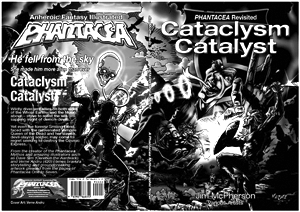
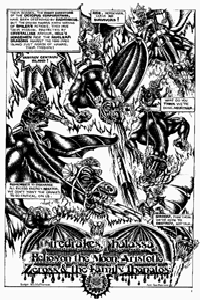
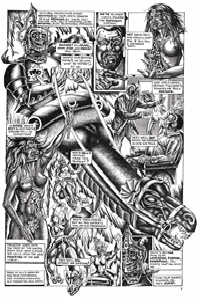
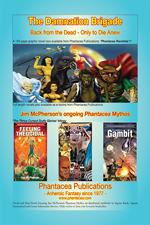
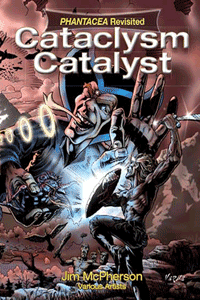
Phantacea Revisited 2Now available for ordering online, the third graphic novel from Phantacea Publications extracts the complete 'Soldier's Saga' from Phantacea 2-6 as well as the 'Hell's Horsmen' sequence as drawn for pH-7 and the 'Origin of the Devil' from the Phantacea Phase One project. Illustrators include Dave Sim, Ian Fry, Sean Newton, Verne Andrusiek (later Andru), and Ian Bateson; full colour cover by Verne Andru off his black and white Rhadamanthys Revealed proposal as reproduced here and here; dedicated webpage is here. - Double-click to enlarge in a separate window here and here - |
What was once, will be again
Thirty-six years after its original release, Jim McPherson completes his Launch 1980 project to novelize all the Phantacea comic books with the release of pH-3 artwork by Richard Sandoval, 1978; rollover adjustments made by Jim McPherson, 2013Double-click to enlarge images in this panel here |
Top of Page - Quick Lynx - Upwards - Downwards - Fresh Graphics - Bottom of Page Ordering Lynx |
||
Phantacea Seven- The unpublished comic now novelized -
At long last, the second entry in the Launch 1980 epic fantasy has arrived Check out the expanded Availability Listings for places you can order or buy Phantacea Publications in person Images in this row double-click to enlarge here |
Jim McPherson continues his ongoing project to novelize the entire Phantacea comic book seriesDouble-click on image to enlarge in a separate windowDedicated webpage can be found here; back cover text here; lynx to excerpts from the book start here and here; check out material that didn't make it here and related excerpts from its scheduled follow-up, 2014's |
Centauri Island- The web-serial enlarged radically -
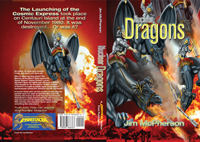
Ian Bateson's unpublished artwork from Phantacea Seven provides the basis for the first full-length phantacea Mythos Mosaic Novel since Ian Bateson's breathtaking wraparound cover for the novel utilizes his own dragons from pH-7. Those from the unfinished cover for the Phantacea Phase One project can be seen here and here. Images in this row double-click to enlarge here and here |
Top of Page - Quick Lynx - Upwards - Downwards - Fresh Graphics - Bottom of Page Ordering Lynx |
||
Phantacea Revisited 1
Check out the expanded Availability Listings for places you can order or buy Phantacea Publications in person NEW: Read most of the mini-novels making up "The Thousand Days of Disbelief" today on Google Books Hit here to see what else is currently available there |
Guess what isn't coming soon any more?
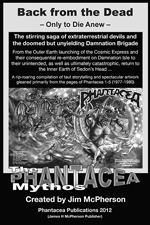
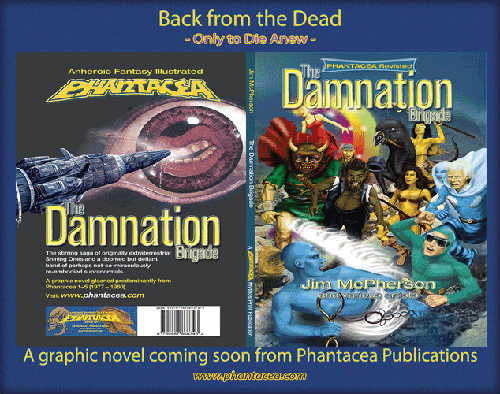
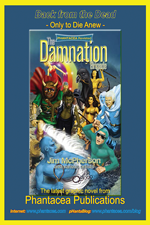
Phantacea Revisited 1: The Damnation Brigade"A Watermarked PDF of the graphic novel can be ordered from Drive Thru Comics here
|
The Damnation Brigade Graphic Novel
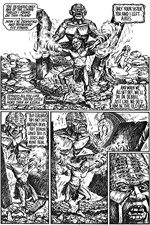
Artwork never seen before in print; almost all of pH-5 available for the first time since 1980 Images in this row double-click to enlarge here |
Top of Page - Quick Lynx - Upwards - Downwards - Fresh Graphics - Bottom of Page Ordering Lynx |
||
No wonder they call themselves the Damnation Brigade
Now available from Phantacea Publications Images in this row are double-clickable from here, here, and, to a lesser degree, here. |
pHantaBlog On
Register now and contribute whenever you pleaseThe 2006 PDF of Mythos Mag, with its updated 2012 lynx, can be downloaded here. Hit here for a Really Simple Syndication (RSS) of the most recent pHantaBlog entries |
The Phantacea Revisited Project
Collecting the Phantacea comic books 1977-1980, 1987, Rv1:DB contains material from pH #s 1-5 + pHz1 #s 1 & 2. This will be the first time in the better part of 30 years that material from pH-5 has been available except from online traders. Watch for
|
Top of Page - Quick Lynx - Upwards - Downwards - Fresh Graphics - Bottom of Page Ordering Lynx |
||
|
||
Top of Page - Quick Lynx - Upwards - Downwards - Bottom of Page Ordering Lynx |
||
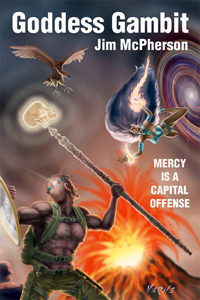
"Goddess Gambit"– Now available from Phantacea Publications –
Thus Ends
|
||
Top of Page - Quick Lynx - Upwards - Downwards - Bottom of Page Ordering Lynx |
||
|
||
Top of Page - Quick Lynx - Upwards - Downwards - Bottom of Page Ordering Lynx |
||
If they're not, kindly direct local librarians and neighbourhood booksellers to www.phantacea.com in order to start rectifying that sad situation. Either that or, if you're feeling even more proactive, click here, copy the link, paste it into an email and send it to them, along with everyone else you reckon could use a double dose of anheroic fantasy. It will certainly be appreciated. Help build the buzz. The more books sell, the faster the PHANTACEA Mythos spreads. |
||
Top of Page - Quick Lynx - Upwards - Downwards - Bottom of Page Ordering Lynx |
||
Individual copies of Libraries, bookstores and bookseller collectives can place bulk orders through Ingram Books, Ingram International, Baker & Taylor, Coutts Information Services, and a large number of other distributors worldwide. E-books for Kindle, Kindle Fire, I-pad, I-phone and other applications can be ordered through amazon.com, amazon.co.uk and other amazon affiliates worldwide. An interactive e-book containing the entirety of BookFinder.com lists the latest releases from Phantacea Publications along with a goodly number of additional booksellers carrying them. Also listed therein are almost all of the PHANTACEA Mythos print and e-publications, including the graphic novel and some of the comic books. Another interesting option for the curious is Chegg, which has a rent-a-book program. Thus far its search engine shows no results for phantacea (any style or permutation thereof) but it does recognize Jim McPherson (a variety of them) and the titles of many releases from Phantacea Publications. As for the Whole Earth (other than the Hidden Continent of Sedon's Head, at least as far as I can say and always assuming it's still around in what be its 61st century), well, this page contains a list of a few other websites where you can probably order the novels in a variety of currencies and with credit cards. Of course you can always email or send me your order(s) via surface mail. No matter where you live or what currency you prefer to use, I'll figure out a way to fill your order(s) myself. Just be aware that I can only accept certified cheques or money orders. Plus, I'll have to charge an additional 12% to cover Canadian and provincial goods and sales taxes as well as Canada Post rates for shipping. I do use bubble mailers, though. |
||




Top of page - Page contents - Bottom of Page Ordering Lynx
Faeries & PHANTACEA |
||
Lynx to other Photo Essays online| Serendipity | Beehive Ghost Houses | Sedon's Head: Inspiration or Destination | Glossaries of Peculiarities | Faeries | Egyptian Evocations | Travels in my Pants | PHANTACEA Essentials | |
| Faerie facts in phantacea | March 1998 | August 1998 | Publications in Print | |

© copyright Jim McPherson |
| | pH-Webworld's Welcoming Page | Internal Search Engine | Main Menu | Online PHANTACEA Primer | Ongoing PHANTACEA Features | pHantaBlog | Information for ordering by credit card | Information for ordering by certified cheque or money order | Serial Synopses | Contact | pH-Webworld Miscellanea | Lynx to additional websites featuring Jim McPherson's PHANTACEA Mythos | Bottom of Page Lynx | | ||

Top of page - Page Contents - Bottom of Page Ordering Lynx
Winter 2009/10
|
Top of page - Page Contents - Bottom of Page Ordering Lynx
August 1998As mentioned last time, I've a theory that the aliens in X-Files are faeries. Although I haven't seen the movie as yet, I understand I was essentially
right.
That is, demons as opposed to devils. Which, as everyone knows -- everyone who read last month's publisher's comments anyhow -- are Fallen Angels. Which would make them catholic, universal, or skyborn. Would also make them devazurs. At least in PHANTACEA. Of course I tend to see faeries, at least their hardened and not so hardened remains, all over the place: in trees, in rock formations, and even on my clothes shelf. And, because I'm such a sharing sort, I've illustrated this page with a few of my favourite, relatively recent photographs of faeries and demons.  
Some, by the way, are supposed to be faeries or, like the shots of the Yucatan's distinctive temples, demons; others are just faces and things I've spotted where there shouldn't be faces and things. I've even spotted a faerie place, possibly Teamhair or Tara, where there should be the City of London. Not that that should surprise anyone. Faerie places can appear damn near anywhere they please. Even London! So, what does all this say about me? Other than I've a decent imagination. Not a great deal. Some nice pictures though. Too bad some of them didn't reproduce as well as I'd've liked but, then again, some of them reproduced better than I thought they would. |


Top of page - Page Contents - Bottom of Page Ordering Lynx
March 1998I've this theory about the X-Files. While UFOs and aliens might be the hook that attracts the audience; while theories of some great governmental conspiracy to engender super beings (PHANTACEA's supras), by splicing human with exotic DNA, might be the underlying theme that holds it together; what it's really about is faeries. Yep, faeries. You heard it here first! Why faeries, you might ask. To which I won't answer 'why not?' but will ask, instead, why aliens? I mean, haven't we got enough of them already? What's Celestial God but an alien? And if Lucifer and his ilk are Fallen Angels, heavens above!, where did they fall from except, well, Outer Space? By contrast, faeries and their cousins, the daemons or daimones (agatho, caco, or whatever), are nothing if not homegrown talent. Am I making this up? The usual answer's 'always' but, in this case, consider the evidence. First of all, look in the dictionary. In mine, for example, demons are defined as: "supernatural entities of 'a secondary rank' (my emphasis, not Funk & Wagnalls); a guardian spirit, a genius." And what's a genius if not a djinn or genie? No UFOs them; not in Aladdin's time anyhow. Here's another interesting, albeit uncommon, word: chthonian (pronounced 'tho-ne-an') or chthonic (i.e. no 'ch' -- so why's it there, you might ask. Don't know, I might answer.) It's defined as: "in ancient mythology, pertaining to the gods and spirits of the underworld." In short, earthborn. Its opposite may or may not be catholic, as in universal, as in Outer Space again.
It wouldn't surprise me if the writers and creators of X-Files keep a copy of Katharine Briggs excellent, and thoroughly researched, 'Dictionary of Fairies' (Penguin Books, 1977) by their bedsides for inspiration. After all, until aliens became everyone's favourite bogeyman, there were plenty of gremlins, spooks, and such like 'things that go bump in the nightmare' to keep us, and our ancestors, well and truly terrified damn near every hour of the day. [Not to mention during prime time.]
One of my favourite resources for the PHANTACEA series of stories is 'The Greek Myths' (Penguin Books, 1955) by Robert Graves. He's the man probably best known for writing the 'I, Claudius' (Penguin Books, circa 1934) pair of books so brilliantly adapted for, or at least presented on, Public TV howsoever many years ago now.
[He also notes that the Milesian (Phoenician) invaders of Ireland thought the world began in 5004 B.C. This is roughly a thousand years before the Moloch Sedon raised the Cathonic Zone in PHANTACEA but, for what it's worth, around the same time I place the birth of Droch Nor {the Biblical Enoch}, the Sixth Patriarch of Golden Age Humankind and the one who was killed when the Sedonshem came to Earth in 4669 B.C.] That the gods and goddesses, the demons and monsters, of Ancient Mythologies all stem from essentially the same source is, of course, one of the precepts of PHANTACEA, -- always has been and always
will be. In one section of Goddess though, Graves speaks of the Sea Peoples, the otherwise unnamed Biblical invaders of Egypt and Palestine after the destruction of Aegean Santorini sometime around 1500 B.C. Lots of folks share my analyses that the Sea Peoples (supposedly the ancestors of the Philistines of David and Goliath fame) were Cretans or, to be more specific, the Etocretans,-- the original inhabitants of Aegean Crete. They're the folks who gave us, among many another stirring saga, the myths of the Minotaur and the disastrous flight of Icarus. [Let's not even get into the Minelaphos (Stag-Man) Cults, which Graves claims dates back to the cave paintings of the Neolithic, or truly Stone Age, times of 20-odd thousand years ago in the Spanish and French Pyrennes.] However, on page 207 of Goddess, Graves also identifies the Sea Peoples with the Irish Sidhe (pronounced 'shee', I understand). He writes: "The Sidhe are now popularly regarded as fairies: but in early Irish poetry they appear as real people -- a highly cultured and dwindling nation of warriors and poets living in raths or round, stockaded forts." (Sound familiar?) Similarly, a much more contemporary author, Stephen R. Lawhead, in his 'Pendragon Cycle' (Avon Fantasy, circa 1988) identifies the survivors of Atlantis, PHANTACEA's Old Eden, as the Fair
Folk or fairies. As well, back in the late Seventies, early Eighties, Julian May featured fairies in her tetralogy, 'The Saga of the Pliocene Era' (Del Rey Science Fiction). May called them the Tanu and the Firvulag,-- pretty clearly the Dana (after the Roman Diana) or the Danu (Tuatha De Danann), the 'good' gods of Old Ireland, and the Fomorii, the 'evil' gods of Old Ireland. (See: 'Irish Mythology', Oxford University Press, 1987). In May's stories they lived in the Mediterranean Basin, around the nowadays so-called Tethys Sea, before the Atlantic Ocean burst through the Pillars of Hercules (Gibraltar) at the end of the, obviously, Pliocene Age some six million years ago. However, according to, among others, David Hatcher Childress in his fascinating 'Lost Cities' (Adventures Unlimited Press) series, this same area was the heartland of the Osirian Civilization. [Note: I say fascinating but, then again, I'm essentially a nice guy. Had there been indexes provided I might have even said something like 'altogether enjoyable'!] When the Mediterranean flooded in the, Childress says, later stages of the last Ice Age (under 10,000 years ago), the survivors made it to Crete, North Africa (most famously Pharaonic Egypt), and as far east as Asia Minor, where they established the Hittite Empire, and the Black or Friendly Sea, where they became the Scythians. Also according to Childress, the Osirian Civilization was contemporaneous with the Rama Empire of Antique India. In fact, he suggests, the two may have went at it with all sorts of exotic weaponry including flying machines called vimanas (mercury-driven engines) or shems (airplanes?) and even nuclear-powered lances (rockets?). As proof of his theory, Childress directs our attention to Mohenjo Daro, Harappa, and other ruins of this Sumerian-era, Indus Valley civilization, once located in modern Pakistan. He seems convinced that the high levels of radiation found there to this day can be explained by nothing less than an at least moderately-scaled Atomic War in the far distant past. [I'll take his word for it. So might you. Mind you, I accept it as a given that there's a Sedon's Head. Of course, despite all the evidence I've presented throughout these Web Pages that there is indeed a Headworld,
you might not go quite that far.] The point of all this? Other than to tout a few interesting books and provide some background for this time up's penultimate chapter of Apocalyptics? To get myself a job writing for the X-Files? (Hey, I do live in Vancouver, where it's shot, at least for now, and don't my neighbours claim to see Agent Muldaur jogging by every so often?) No, the point of all this is to ever-so-cleverly lead into my next installment of PHANTACEA on the Web -- which is when I hope to mount a gallery of shots of Tholoi Shrines or Ghost Houses that I took during my most recent travels. Tholoi? They'd be related to the rounded raths (whatever they are!) noted above. |







Top of page - Page Contents - Bottom of Page Ordering Lynx
Phantacea Publications in Print- The 'Launch 1980' story cycle - 'The Thrice-Cursed Godly Glories' Fantasy Trilogy - The '1000 Days' Mini-Novels - The phantacea Graphic Novels - |
||
The 'Launch 1980' Story Cycle |
||
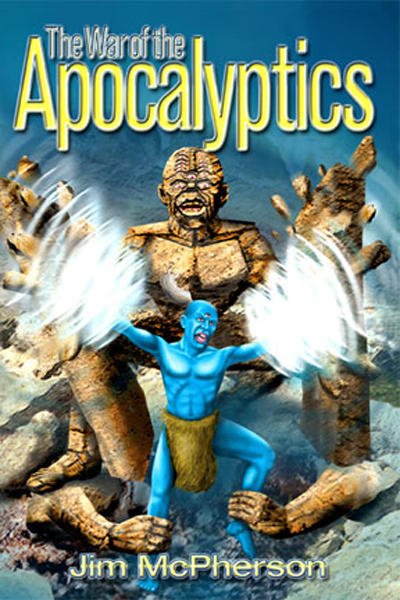
The War of the Apocalyptics
Published in 2009; main webpage is here; ordering lynx are here; |
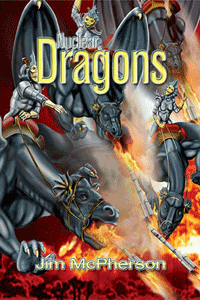
Nuclear Dragons
Published in 2013; main webpage is here; ordering lynx are here; |
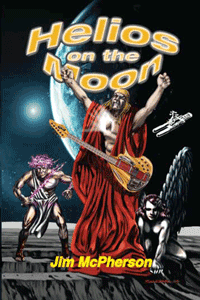
Helios on the Moon
Published in 2014; main webpage is here; ordering lynx are here; |
The 'Launch 1980' story cycle comprises three complete, multi-character mosaic novels, |
||
Top of Page Search Engine - pHantaPubs in Print - Page Highlights - Upwards - Downwards - Fresh Graphics - Bottom of Page Ordering Lynx |
||
'The Thrice-Cursed Godly Glories' Epic Fantasy |
||
Feeling Theocidal
Published in 2008; main webpage is here; ordering lynx are here |
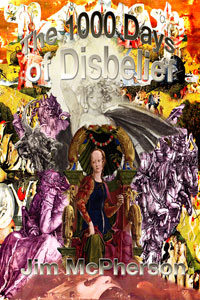
The 1000 Days of Disbelief
Published as three mini-novels, 2010/11; main webpage is here; ordering lynx for individual mini-novels are here |
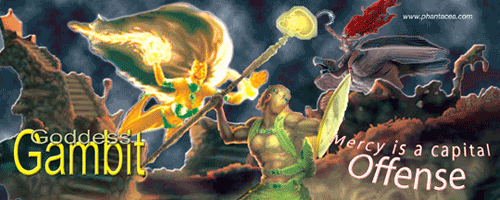
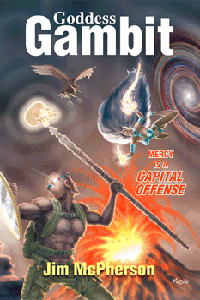
Goddess Gambit
Published in 2012; main webpage is here; ordering lynx are here |
Circa the Year of Dome 2000, Anvil the Artificer, a then otherwise unnamed, highborn Lazaremist later called Tvasitar Smithmonger, dedicated the first three devic talismans, or power foci, that he forged out of molten Brainrock to the Trigregos Sisters. The long lost, possibly even dead, simultaneous mothers of devakind hated their offspring for abandoning them on the far-off planetary Utopia of New Weir. Not surprisingly, their fearsome talismans could be used to kill Master Devas (devils). For most of twenty-five hundred years, they belonged to the recurring deviant, Chrysaor Attis, time after time proven a devaslayer. On Thrygragon, Mithramas Day 4376 YD, he turned them over to his Great God of a half-father, Thrygragos Varuna Mithras, to use against his two brothers, Unmoving Byron and Little Star Lazareme, in hopes of usurping their adherents and claiming them as his own. Hundreds of years later, these selfsame thrice-cursed Godly Glories helped turn the devil-worshippers of Sedon's Head against their seemingly immortal, if not necessarily undying gods. Now, five hundred years after the 1000 Days of Disbelief, they've been relocated. The highest born, surviving devic goddesses want them for themselves; want to thereby become incarnations of the Trigregos Sisters on the Hidden Continent. An Outer Earthling, one who has literally fallen out of the sky after the launching of the Cosmic Express, gets to them first ... |
||
Top of Page Search Engine - pHantaPubs in Print - Page Highlights - Upwards - Downwards - Fresh Graphics - Bottom of Page Ordering Lynx |
||
The '1000 Days' Mini-Novels |
||
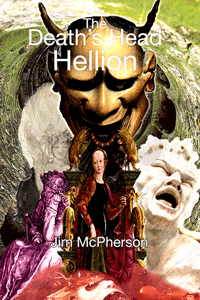
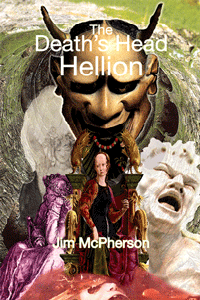
The Death's Head Hellion- Sedonplay -
Published in 2010; main web presence is here; Character Companion starts here; ordering lynx are here; |
Contagion Collectors- Sedon Plague -
Published in 2010; main web presence is here; Character Companion starts here; ordering lynx are here; |
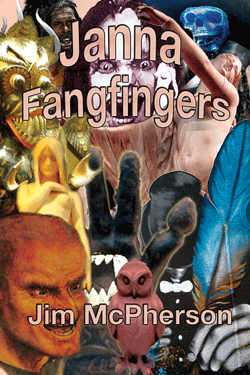
Janna Fangfingers- Sedon Purge -
Published in 2011; two storylines recounted side-by-side, the titular one narrated by the Legendarian in 5980, the other indirectly leading into the 'Launch 1980' story cycle; main web presence is here; Character Companion starts here; ordering lynx are here; |
In the Year of the Dome 4825, Morgan Abyss, the Melusine Master of the Utopian Weirdom of Cabalarkon, seizes control of Primeval Lilith, the ageless, seemingly unkillable Demon Queen of the Night. The eldritch earthborn is the real half-mother of the invariably mortal Sed-sons but, once she has hold of her, aka Lethal Lily, Master Morgan proceeds to trap the Moloch Sedon Himself. In the midst of the bitter, century-long expansion of the Lathakran Empire, the Hidden Headworld's three tribes of devil-gods are forced to unite in an effort to release their All-Father. Unfortunately for them, they're initially unaware Master Morg, the Death's Head Hellion herself, has also got hold of the Trigregos Talismans, devic power foci that can actually kill devils, and Sedon's thought-father Cabalarkon, the Undying Utopian she'll happily slay if they dare attack her Weirdom. Utopians from Weir have never given up seeking to wipe devils off not just the face of the Inner Earth, but off the planet itself. Their techno and biomages, under the direction of the Weirdom of Cabalarkon's extremely long-lived High Illuminary, Quoits Tethys, have determined there is only one sure way to do that -- namely, to infect the devils' Inner Earth worshippers with fatal plagues brought in from the Outer Earth. Come All-Death Day there are more Dead Things Walking than Living Beings Talking. Believe it or not, that's the good news. |
||
Top of Page Search Engine - pHantaPubs in Print - Page Highlights - Upwards - Downwards - Fresh Graphics - Bottom of Page Ordering Lynx |
||
phantacea Graphic Novels |
||
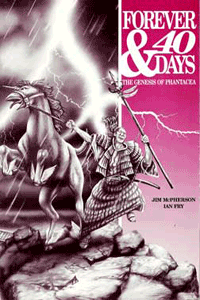
Forever and Forty Days- The Genesis of Phantacea -
Published in 1990; main webpage is here; ordering lynx are here |
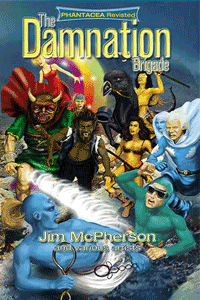
The Damnation Brigade- Phantacea Revisited 1 -
Published in 2013; main webpage is here; ordering lynx are here |
Cataclysm Catalyst- Phantacea Revisited 2 -
Published in 2014, main webpage is here; ordering lynx are here |
Kadmon Heliopolis had one life. It ended in October 1968. The Male Entity has had many lives. In his fifth, he and his female counterpart, often known as Miracle Memory, engendered more so than created the Moloch Sedon. They believe him to be the Devil Incarnate. They've been attempting to kill him ever since. Too bad it's invariably he, Heliosophos (Helios called Sophos the Wise), who gets killed instead. On the then still Whole Earth circa the Year 4000 BCE, one of their descendants, Xuthros Hor, the tenth patriarch of Golden Age Humanity, puts into action a thought-foolproof, albeit mass murderous, plan to succeed where the Dual Entities have always failed. He unleashes the Genesea. The Devil takes a bath. Fifty-nine hundred and eighty years later, New Century Enterprises launches the Cosmic Express from Centauri Island. It never reaches Outer Space; not all of it anyhow. As a stunning consequence of its apparent destruction, ten extraordinary supranormals are reunited, bodies, souls and minds, after a quarter century in what they've come to consider Limbo. They name themselves the Damnation Brigade. And so it appears they are -- if perhaps not so much damned as doomed. At least one person survives the launching of the Cosmic Express. He literally falls out of the sky -- on the Hidden Continent of Sedon's Head. An old lady saves him. Except this old lady lives in a golden pagoda, rides vultures and has a third eye. She also doesn't stay old long. He becomes her willing soldier, acquires the three Sacred Objects and goes on a rampage, against his own people, those that live. Meanwhile, Centauri Island, the launch site of the Cosmic Express, comes under attack from Hell's Horsemen. Only it's not horses they ride. It's Atomic Firedrakes! |
||




Top of page - Page Contents - Bottom of Page Ordering Lynx
Webpage last updated: Winter 2009/10There may be no cure for aphantasia (defined as 'having a blind or absent mind's eye') but there certainly is for aphantacea ('a'='without', like the 'an' in 'anheroic') Ordering Information for PHANTACEA Mythos comic books, graphic novels, standalone novels, mini-novels and e-books
|