pH-Webworld - bypass banners - quick lynx - bottom of page lynx
Lynx for pHantaBlog RSS: http://phantacea.com/blog/?feed=rss2
This free script provided by
JavaScript Kit
Phantacea Publications in Print- The 'Launch 1980' story cycle - 'The Thrice-Cursed Godly Glories' Fantasy Trilogy - The '1000 Days' Mini-Novels - The phantacea Graphic Novels - |
||
The 'Launch 1980' Story Cycle |
||
The War of the Apocalyptics
Published in 2009; main webpage is here; ordering lynx are here; |
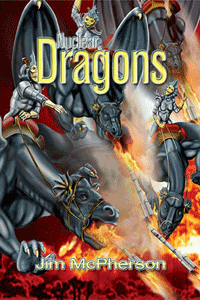
Nuclear Dragons
Published in 2013; main webpage is here; ordering lynx are here; |
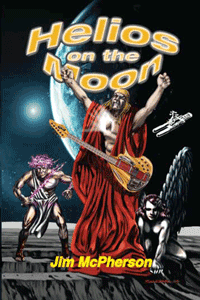
Helios on the Moon
Published in 2014; main webpage is here; ordering lynx are here; |
The 'Launch 1980' story cycle comprises three complete, multi-character mosaic novels, |
||
Top of Page Search Engine - pHantaPubs in Print - Page Highlights - Upwards - Downwards - Fresh Graphics - Bottom of Page Ordering Lynx |
||
'The Thrice-Cursed Godly Glories' Epic Fantasy |
||
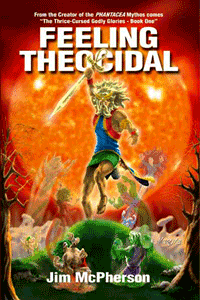
Feeling Theocidal
Published in 2008; main webpage is here; ordering lynx are here |
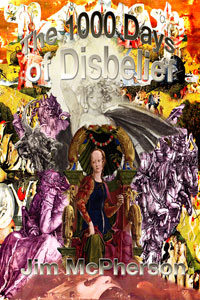
The 1000 Days of Disbelief
Published as three mini-novels, 2010/11; main webpage is here; ordering lynx for individual mini-novels are here |
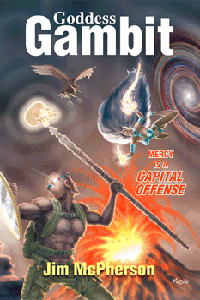
Goddess Gambit
Published in 2012; main webpage is here; ordering lynx are here |
Circa the Year of Dome 2000, Anvil the Artificer, a then otherwise unnamed, highborn Lazaremist later called Tvasitar Smithmonger, dedicated the first three devic talismans, or power foci, that he forged out of molten Brainrock to the Trigregos Sisters. The long lost, possibly even dead, simultaneous mothers of devakind hated their offspring for abandoning them on the far-off planetary Utopia of New Weir. Not surprisingly, their fearsome talismans could be used to kill Master Devas (devils). For most of twenty-five hundred years, they belonged to the recurring deviant, Chrysaor Attis, time after time proven a devaslayer. On Thrygragon, Mithramas Day 4376 YD, he turned them over to his Great God of a half-father, Thrygragos Varuna Mithras, to use against his two brothers, Unmoving Byron and Little Star Lazareme, in hopes of usurping their adherents and claiming them as his own. Hundreds of years later, these selfsame thrice-cursed Godly Glories helped turn the devil-worshippers of Sedon's Head against their seemingly immortal, if not necessarily undying gods. Now, five hundred years after the 1000 Days of Disbelief, they've been relocated. The highest born, surviving devic goddesses want them for themselves; want to thereby become incarnations of the Trigregos Sisters on the Hidden Continent. An Outer Earthling, one who has literally fallen out of the sky after the launching of the Cosmic Express, gets to them first ... |
||
Top of Page Search Engine - pHantaPubs in Print - Page Highlights - Upwards - Downwards - Fresh Graphics - Bottom of Page Ordering Lynx |
||
The '1000 Days' Mini-Novels |
||
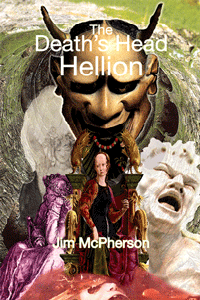
The Death's Head Hellion- Sedonplay -
Published in 2010; main web presence is here; Character Companion starts here; ordering lynx are here; |
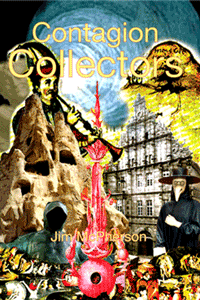
Contagion Collectors- Sedon Plague -
Published in 2010; main web presence is here; Character Companion starts here; ordering lynx are here; |
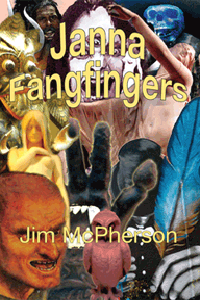
Janna Fangfingers- Sedon Purge -
Published in 2011; two storylines recounted side-by-side, the titular one narrated by the Legendarian in 5980, the other indirectly leading into the 'Launch 1980' story cycle; main web presence is here; Character Companion starts here; ordering lynx are here; |
In the Year of the Dome 4825, Morgan Abyss, the Melusine Master of the Utopian Weirdom of Cabalarkon, seizes control of Primeval Lilith, the ageless, seemingly unkillable Demon Queen of the Night. The eldritch earthborn is the real half-mother of the invariably mortal Sed-sons but, once she has hold of her, aka Lethal Lily, Master Morgan proceeds to trap the Moloch Sedon Himself. In the midst of the bitter, century-long expansion of the Lathakran Empire, the Hidden Headworld's three tribes of devil-gods are forced to unite in an effort to release their All-Father. Unfortunately for them, they're initially unaware Master Morg, the Death's Head Hellion herself, has also got hold of the Trigregos Talismans, devic power foci that can actually kill devils, and Sedon's thought-father Cabalarkon, the Undying Utopian she'll happily slay if they dare attack her Weirdom. Utopians from Weir have never given up seeking to wipe devils off not just the face of the Inner Earth, but off the planet itself. Their techno and biomages, under the direction of the Weirdom of Cabalarkon's extremely long-lived High Illuminary, Quoits Tethys, have determined there is only one sure way to do that -- namely, to infect the devils' Inner Earth worshippers with fatal plagues brought in from the Outer Earth. Come All-Death Day there are more Dead Things Walking than Living Beings Talking. Believe it or not, that's the good news. |
||
Top of Page Search Engine - pHantaPubs in Print - Page Highlights - Upwards - Downwards - Fresh Graphics - Bottom of Page Ordering Lynx |
||
phantacea Graphic Novels |
||
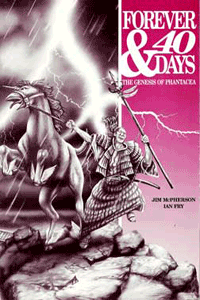
Forever and Forty Days- The Genesis of Phantacea -
Published in 1990; main webpage is here; ordering lynx are here |
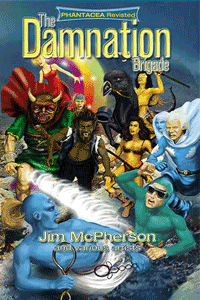
The Damnation Brigade- Phantacea Revisited 1 -
Published in 2013; main webpage is here; ordering lynx are here |
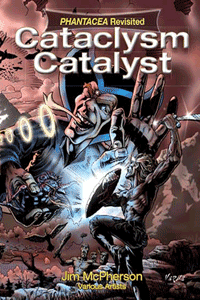
Cataclysm Catalyst- Phantacea Revisited 2 -
Published in 2014, main webpage is here; ordering lynx are here |
Kadmon Heliopolis had one life. It ended in October 1968. The Male Entity has had many lives. In his fifth, he and his female counterpart, often known as Miracle Memory, engendered more so than created the Moloch Sedon. They believe him to be the Devil Incarnate. They've been attempting to kill him ever since. Too bad it's invariably he, Heliosophos (Helios called Sophos the Wise), who gets killed instead. On the then still Whole Earth circa the Year 4000 BCE, one of their descendants, Xuthros Hor, the tenth patriarch of Golden Age Humanity, puts into action a thought-foolproof, albeit mass murderous, plan to succeed where the Dual Entities have always failed. He unleashes the Genesea. The Devil takes a bath. Fifty-nine hundred and eighty years later, New Century Enterprises launches the Cosmic Express from Centauri Island. It never reaches Outer Space; not all of it anyhow. As a stunning consequence of its apparent destruction, ten extraordinary supranormals are reunited, bodies, souls and minds, after a quarter century in what they've come to consider Limbo. They name themselves the Damnation Brigade. And so it appears they are -- if perhaps not so much damned as doomed. At least one person survives the launching of the Cosmic Express. He literally falls out of the sky -- on the Hidden Continent of Sedon's Head. An old lady saves him. Except this old lady lives in a golden pagoda, rides vultures and has a third eye. She also doesn't stay old long. He becomes her willing soldier, acquires the three Sacred Objects and goes on a rampage, against his own people, those that live. Meanwhile, Centauri Island, the launch site of the Cosmic Express, comes under attack from Hell's Horsemen. Only it's not horses they ride. It's Atomic Firedrakes! |
||

Top of Page Search Engine - Contents - Upwards - Downwards - Bottom of Page Lynx
Jim McPherson's Phantacea Mythos Online
|
||
Sedon's HeadInspiration or Destination? |
||
|
|
Lynx to other pH-Webworld Photo Essays| Essentials | Serendipity | Beehive Ghost Houses | Sedon's Head: Inspiration or Destination | Glossaries of Peculiarities | Faeries | Egyptian Evocations | Travels in my Pants | |
|
| | pH-Webworld's Welcoming Page | Internal Search Engine | Main Menu | Online PHANTACEA Primer | Ongoing PHANTACEA Features | pHantaBlog | Information for ordering by credit card | Information for ordering by certified cheque or money order | Serial Synopses | Contact | pH-Webworld Miscellanea | Lynx to additional websites featuring Jim McPherson's PHANTACEA Mythos | Bottom of Page Lynx | | ||



Top of Page Search Engine - Contents - Upwards - Downwards - Bottom of Page Lynx
Growing
up I was accounted as having a fertile imagination,
-- although I have to admit there were some who said it was febrile.

Wouldn't it be interesting, I thought, if there was an actual Headworld, a place where not just me but anyone who knew how could go? That in mind I drew one up. It looked something like the image on the right of this paragraph. This Headworld had to have a name and, not wanting to be exclusive, I could not very well call it Jim's Headworld, could I? So for reasons that are still somewhat of a mystery to me I called it Sedon's Head instead. A number of
years later, in the late Seventies, I decided to put out my own comic
book series. Which I did; called it PHANTACEA
and wrote and published six issues before I ran out of money. Pass forward
some more years, into the mid-Eighties. Around that time I sold an enormous
amount of back issues. Which of course meant I could publish more comic
books. Which I did, including a graphic novel entitled 
Not being a complete idiot I decided I would not be self-publishing any more comic books or, especially, any more graphic novels. I still had all these characters, though, and had been afflicted with the writing bug since long before I came up with Sedon's Head. I bought a Smith Corona PWP (Personal Word Processor) with some of the proceeds from selling all those aforementioned back issues of the original comic book series and purchased my first personal computer, an IBM, in the early Nineties. Along comes the Worldwide Web and, after learning HTML, mostly from a book, I launched PHANTACEA on the Web in 1996. Idea was to put up my weekend writings and sell disks with complete novels on them for $10 U.S. Sold a few too. Which partially explains why I started having money again. I took to travelling farther afield during my vacations. (Yes, I had a regular job in those days. As any would-be writer learns at an early age you don't give up your day job for the sake of your art. Or artlessness, as the case may be.) On Crete, which claims a civilization as old as Ancient Egypt, I made what I considered an intriguing and, to my mind, serendipitous discovery. Was a cave I had never heard of before, where all sorts of ancient Etocretan (circa 2000 BC) artefacts were found. Its name? The Sedoni Cave.
I looked up this story in a book called "Ancient Israel: Myths and Legends", which was first published sometime in the early part of the last century I'm guessing. (The copy I have was published by Bonanza Books of New York in 1988. However, its author, Angelo Rappoport, died in 1950.) There the Shedds are called the 'Shedim' and they are referred to as demons. Throughout PHANTACEA the Moloch Sedon is just as commonly referred to as the Demon King. In Lebanon you can find one of the Whole Earth's earliest still extant cities. It's called Sidon. In Egypt, in a place the Greeks called 'Heliopolis', or Sun City, and I understand the Bible called 'On', there was some sort of Pharaonic fertility-affirmation ritual practised called the Sed Ceremony. Which made me wonder if the city was actually called 'Sed-On'. There's more of course. Much more as it happens. For example, New Agers will tell you there's a place in Arizona where ever so many ever so mysterious mystic fields converge. It's name? Sedona! Starting to get where I'm going? (In a book by
Ahmed Osman entitled "Moses and Akhenaten -- The Secret History
of Egypt at the Time of the Exodus", which was first published
in 1990 by Grafton Books and was recently reissued by Bear & Company,
the author claims the Sed Ceremony was held in the Pharaoh's thirtieth
year of ruling and repeated every two or three years thereafter to demonstrate
his continuing suitability for sitting on the throne, or whatever Pharaohs
sat upon back then. Osman does not go into any real details as to what
rituals constituted the Sed Ceremony but if you flip through picture
books of Pharoanic Egypt you will often come across references to something
called the Djed or Zed Pillar. It supposedly represents the backbone
of the god Osiris and symbolizes stability. Might this Djed or Zed pillar
have something to do with the Sed Ceremony. Words certainly sound similar
and, for what it's worth, in English they do rhyme with 'head'.)
Lebanon was once known as Phoenicia. In its Cedar Mountains, where parts of the pre-Biblical Gilgamesh Saga took place, is one of the oldest man or god-made structures in the world. It's called the Trilithon and it's situated in a place known as Baalbek to the locals. The Romans, and the Greeks before them, called it Heliopolis, however. Curiously, besides the Sed Ceremony, Egyptian Heliopolis is reputed to be the birth place of the famous sunbird or Phoenix, who dies in its own flames only to rise anew out of its own ashes. And where do you think the name Phoenicia came from? Could it be from the Phoenix Sunbird? Isn't a matter of could, is it? Ever heard the
Greek myth of Zeus, who was born on Crete, taking the form of a white
bull and carting Europa, from whence came the name for the continent
of Europe, from her birthplace to his birthplace, where they founded
its, the Cretan-Grecian, civilization together? And where was this Europa
from? Phoenicia, as it happens. And who was her brother, he who came
looking for her? Name was Cadmus and, according to mythology, he brought
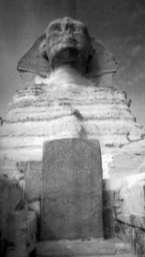
our alphabet to Europe, -- hence phonetics. So, just to review, in the late Sixties I call my Headworld after Sedon, a name I came up with out of the proverbial blue. I make him into the Devil and he becomes the main antagonist in what I now think of as 'The PHANTACEA Mythos'. I thereafter start coming across all these bizarre synchronicities; ones which, thus far on our serendipitous little journey, have led us from Phoenix to Phoenicia to phonetics and back again. Believe me, it only gets weirder. How weird? Try this on, trilithon! I envisioned Sedon's Head as a place, a hidden continent, in effect the Inner Earth to our Outer Earth. Anyone who knew how could go there. One of the ways to go to the Headworld is supposed to be through the, to me, obvious doorway situated between the legs of the Egyptian Sphinx. (I recognize a doorway when I see one and so might you when you take a look at the picture immediately to the right of this paragraph.) It sits on the Giza, or Gizeh, Plateau, not far from the modern day Cairo suburb of, you guessed it, Heliopolis.
So, according to the book, what we have here is an "aerial overview of [the] Giza Pyramid Plateau". Book does not state when, or who by, it was taken. I found out, though, when I went to Cairo in late September, early October 2000 and found the source photograph. It's in one of the Old Kingdom rooms of the Cairo Museum. Turns out it was taken by the Egyptian airforce sometime in the late Twenties or early Thirties. Long-winded point being, -- what's that in what is now, and was in the 20s or 30s, a parking lot? Looks very much like a head, doesn't it? Remind you of any head in particular? Does me. For more peculiar perspectives, synchronous, serendipitous and just plain strange, check out the ongoing PHANTACEA Feature entitled: "Serendipity and PHANTACEA". |

 In the Bible you can read the story of Sodom and Gomorrah, the twin cities that were apparently destroyed around the same time, circa 2000 BC. I'm reliably informed that in the Jewish Talmud there's a story about King Solomon, who reigned
around 1000 BC, and another King, that of the Elementals. His name is Ashmedai but his particular brand of Elementals are called the Shedds.
In the Bible you can read the story of Sodom and Gomorrah, the twin cities that were apparently destroyed around the same time, circa 2000 BC. I'm reliably informed that in the Jewish Talmud there's a story about King Solomon, who reigned
around 1000 BC, and another King, that of the Elementals. His name is Ashmedai but his particular brand of Elementals are called the Shedds.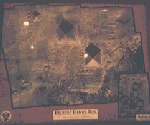

Top of Page Search Engine - Contents - Upwards - Downwards - Bottom of Page Lynx
Webpage last updated: Autumn 2012There may be no cure for aphantasia (defined as 'having a blind or absent mind's eye') but there certainly is for aphantacea ('a'='without', like the 'an' in 'anheroic') Ordering Information for PHANTACEA Mythos comic books, graphic novels, standalone novels, mini-novels and e-books
|